As organizations continue accelerating their digital and AI strategies, many are discovering that customer experience has reached a crossroads. After years of rapid experimentation—new channels, new automation layers, and new platforms—the market is demanding a return to fundamentals: systems that work together, experiences that feel natural, and interactions that solve problems quickly. In 2026, enterprises will not be defined by how many tools they have, but by how seamlessly those tools work together to deliver meaningful outcomes reflecting a broader shift toward simplification, intelligence, and customer‑first designs.
Prediction #1CRM becomes the primary interface for agents in 2026
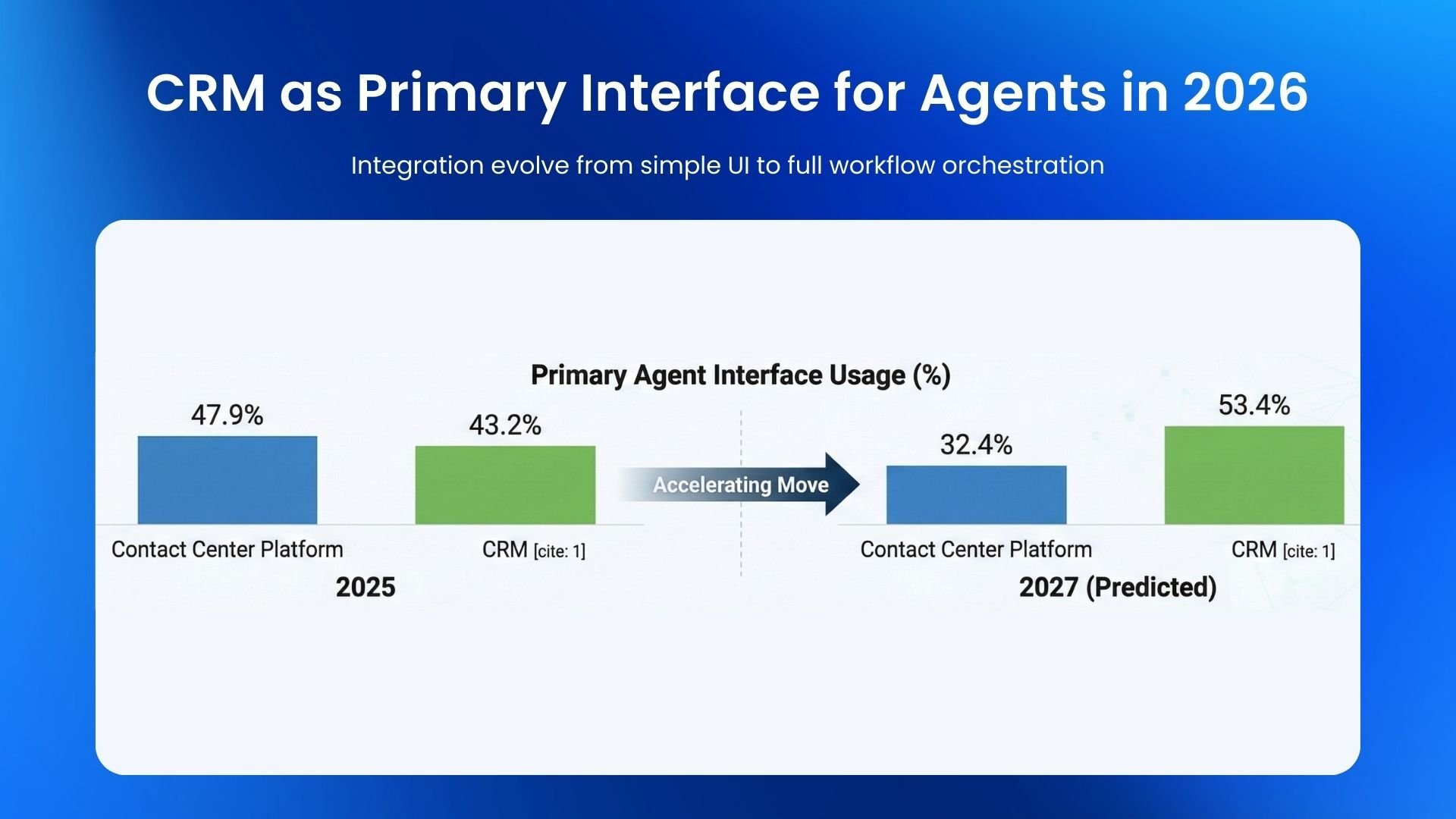
Growing friction between CRM and CCaaS providers is intensifying as integrations evolve from simple UI connections to full workflow orchestration. Agents, whether human or AI, must constantly pull information from CRM, ERP, ITSM, and ticketing systems, making it increasingly unrealistic to tolerate the “swivel‑chairing” of legacy setups. In 2025, 47.9% of companies relied on contact center platforms as the primary agent interface compared to 43.2% for CRMs. By 2027, those numbers will shift to 32.4% and 53.4%, respectively, driven by rising demand for deeper front‑ and back‑office integrations that roughly 58% of IT and CX leaders now consider essential. This trend is accelerating the move to establish CRMs as dominant systems of record, with CCaaS platforms serving as powerful and strategically relevant extensions to them.
Prediction #2Enterprises will re‑center voice as a core CX pillar in 2026
Despite years of investment in digital alternatives, voice continues to outperform every other channel when it comes to resolving complex or emotionally nuanced customer issues. Advances in natural language processing are reinforcing this trend, enabling faster, more intuitive spoken interactions that reduce the need for lengthy chat threads or multi‑step digital journeys. The past decade’s digital transformation push promised seamless automation, but results have been uneven. Meanwhile, 82% of companies expect AI to increase voice traffic, driven by improved speed‑to‑resolution, lower cost per call, and higher customer satisfaction. Whether through human agents, AI‑assisted conversations, or autonomous voice bots, voice is set to regain a central role, not as a fallback, but as a strategic CX differentiator.
CRM becomes the primary interface for agents in 2026
Prediction #3
Voice AI and multimodal experiences become an impactful reality
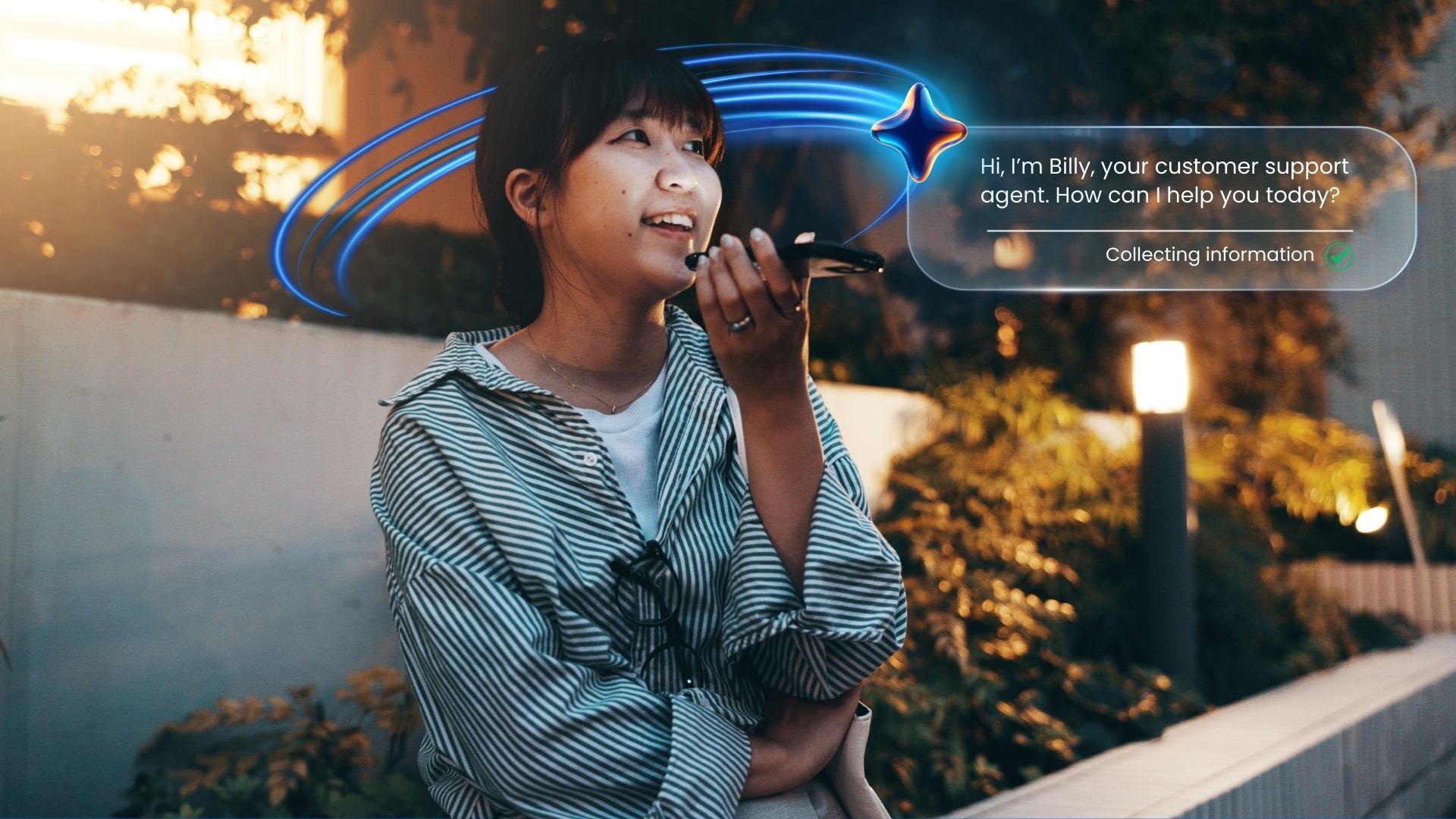
Most contact centers still rely on legacy IVRs that frustrate customers with rigid menus, long wait times, and disconnected handoffs. These outdated systems are costly, not only in operational inefficiency but in customer trust. With modern LLMs, voice is finally getting the reinvention it has long deserved, and 2026 will mark the shift from experimentation to meaningful enterprise‑scale implementation. At the same time, multimodal technologies—voice, text, and vision—will converge, enabling engagements that move fluidly across modes without customers having to think about it. Forget multichannel or omnichannel – CX is entering into a new era of single unified conversational experiences where interactions simply flow.
Prediction #4Data, data, data
Whether an interaction is AI‑driven, human‑driven, or hybrid, the accuracy and real-time accessibility of relevant data at the moment of engagement will determine who wins in CX in 2026. Enterprises are recognizing that AI is only as powerful as the information it can access, and that siloed data remains one of the biggest barriers to modernization. As a result, this year will bring accelerated investment in data cleanup, knowledge‑base restructuring, and consolidation of fragmented systems into unified platforms. These efforts will enable the shift from reactive support to proactive, predictive customer engagement—something only possible when intelligence and data flow freely across the enterprise. Ultimately, the competitive advantage will belong to organizations that treat data as a strategic asset, not an operational afterthought.
Prediction #5The early ushering of AI‑free experiences as a business strategy?
As AI becomes ubiquitous across industries, 2026 may mark the emergence of a counter‑trend: AI‑free or “human‑only” service options positioned as a premium experience. With automation becoming the default, enterprises may start elevating human support as a higher‑value alternative, especially for sensitive, time‑critical, or emotionally charged interactions. This shift is already gaining traction as consumers question whether bots truly grasp context or urgency. Meanwhile, 55% still prefer speaking with a human when facing urgent issues such as unexpected travel disruptions. While AI will continue to drive efficiency, brands may choose to differentiate by offering a clearly defined human‑first service tier, giving customers a meaningful choice in how they engage.
Final thoughts
The CX landscape of 2026 will be defined by convergence, clarity, and customer choice. CRM is taking the lead as the agent interface of the future, voice is reclaiming its position as the most trusted channel, and next‑generation voice AI is redefining what natural interaction looks like. At the same time, data modernization is becoming non‑negotiable, and human‑only experiences may emerge as a strategic counterbalance to widespread automation. For enterprises, the winners will be those who embrace this moment to unify their systems, elevate their voice strategy, and deploy AI with intention—not as a replacement, but as a catalyst for more meaningful, efficient, and human‑centered experiences.
No matter what - 2026 promises to be an exciting year.
No Jitter: The rise of CRM in the contact center
The 2025 State of International Voice for the Contact Center
Zendesk: Global survey reveals growing consumer trust in personal AI assistants