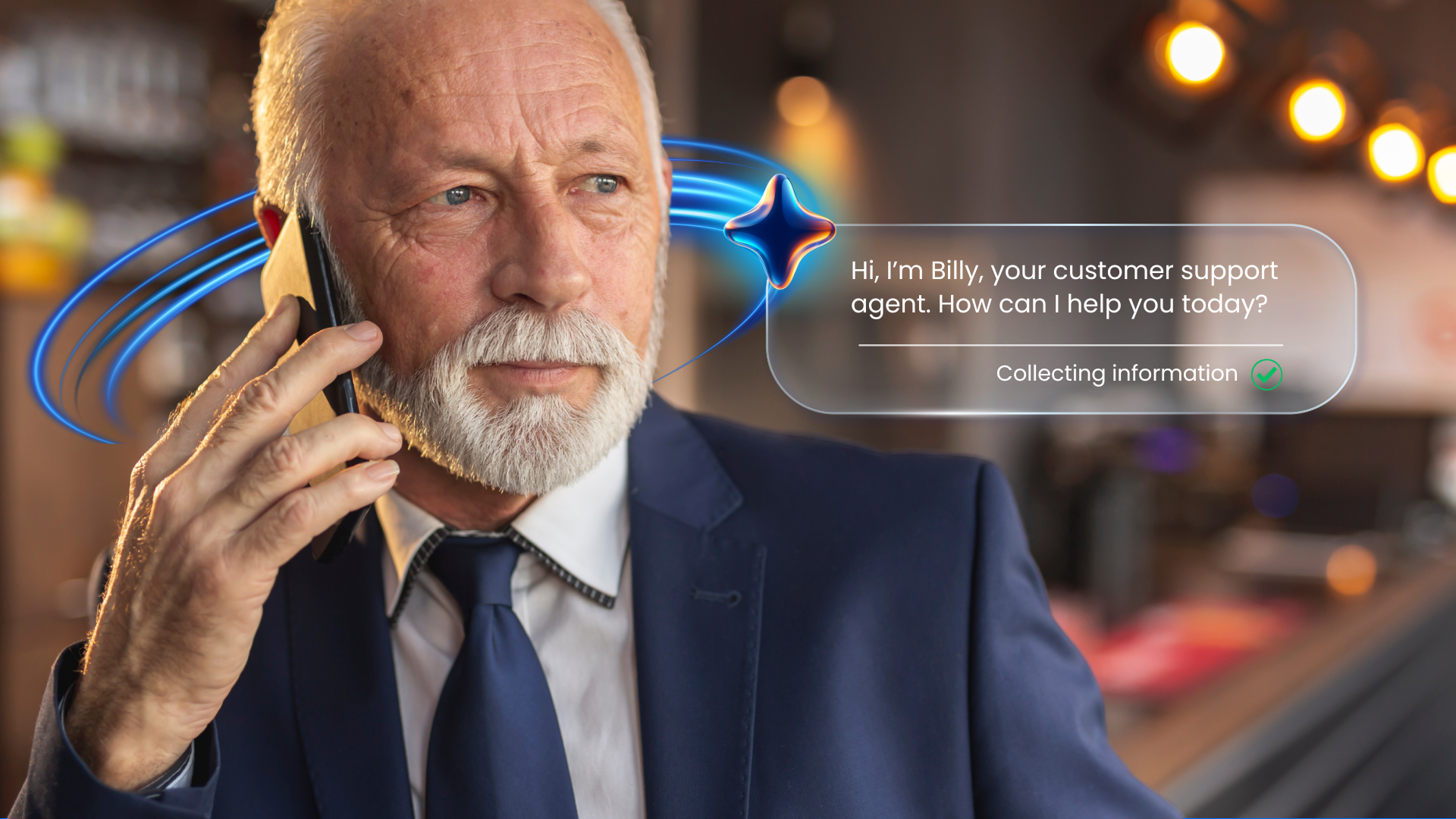

The modern HR service desk, often functioning as the employee contact center, acts as a crucial hub for maintaining business operations and enhancing employee productivity and experience (EX). While critically important, service desks face significant hurdles. To meet these evolving demands, organizations are making a strategic pivot from reactive troubleshooting to proactive, experience-driven support.
What’s holding HR Service Desks back
Modern HR service desks operate under increasing pressure as employee expectations rise and organizational systems lag behind. The result is a complex mix of operational, technological, and human‑centric challenges that make consistent, high‑quality support difficult to deliver.
Technology and data deficits
Many HR teams still rely on fragmented “Frankensystems” that hinder productivity and create daily friction. Only 43% of HR professionals consider their HR technology effective, with siloed tools causing data issues, inefficient workflows, and lost context. Limited analytics make it hard to track performance or spot trends, contributing to an experience gap where only 55% of employees feel fully supported.
High volumes of repetitive queries
A large portion of inquiries involve simple, repeat questions about benefits, payroll, or policies. With 57% of customer care leaders expecting call volumes to increase, this ongoing flood limits HR teams’ ability to focus on more complex, strategic work.
Loss of the human touch
Centralized service models often struggle with sensitive topics like conflict resolution or mental health. Rigid menus, outdated interfaces, and scripted digital responses no longer meet modern standards. Employees increasingly expect empathetic, conversational support. In fact, many still prefer live conversations, with 71% of Gen Z viewing phone calls as the quickest way to resolve issues.
Voice, AI, and Unified Experiences: The future of HR Service Delivery
As HR service desks work to overcome these mounting challenges, a clear shift is emerging: the future of employee support will be built on voice, intelligent automation, and a deeply unified technology ecosystem. These capabilities aren’t about replacing HR professionals—they’re about giving them the tools to deliver faster, more empathetic, and more consistent support at scale.
The rise of the digital-first but not digital only HR Service Experience
Despite the proliferation of digital channels and knowledge portals, voice is rapidly becoming the most natural and intuitive support channel, not just in customer care, but increasingly in employee support. By 2026, more than 75% of enterprise contact centers are expected to deploy AI‑powered voice bots as frontline agents. For HR, this shift offers two major advantages: dramatically reduced handling time for routine requests and a more human, conversational interface that mirrors how employees naturally communicate.
AI that elevates HR—not replaces It
The goal isn’t a “no‑human” HR desk. It’s a model that keeps people in the loop when empathy or expertise really matters. AI excels in two areas:
- Smart self‑service: Voice‑enabled automation can handle common questions—like PTO balances, policy clarifications, or status updates—using natural, human‑like dialogue.
- Agent support: When an issue requires a specialist, AI acts as a powerful co‑pilot. Features like real‑time transcription, automatic call summaries, sentiment analysis, and proactive next‑best‑action suggestions streamline every live interaction. Agents spend less time documenting and searching, and more time genuinely helping employees.
Unifying HR data and workflows for a seamless experience
Much of the friction in HR service delivery comes from disconnected systems that force agents to toggle between tools while employees wait for answers. A unified data and workflow model solves this. Key elements include:
- A single source of truth: Consolidating voice interactions, tickets, and case data within one consistent HR workflow platform eliminates duplicate entry and context loss.
- A unified agent workspace: By merging back‑end HR processes with front‑office channels—voice, chat, and digital portals—agents finally get one coherent view of the employee journey. This level of consistency ensures employees feel heard, valued, and taken care of from the very first interaction.
Voice AI for Intelligent HR Service Desk Automation
This demonstration showcases how Voice AI integrates with ServiceNow to automate common HR service desk inquiries, specifically focusing on PTO (paid time off) requests.
How ServiceNow HR Service Delivery and 3CLogic are Transforming Employee Experiences
As HR service desks evolve toward a more proactive, employee‑centric model, the combination of voice technology, AI, and unified workflows becomes essential. These capabilities work together to streamline resolution, empower agents, and strengthen operational excellence, all while keeping the human touch intact where it matters most.
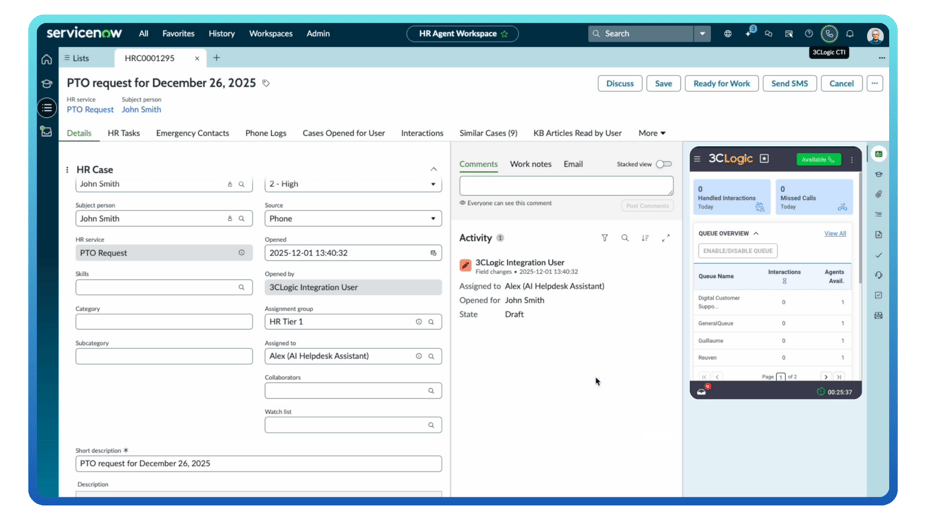
3CLogic's Unified Workspace with ServiceNow
Voice that resolves, rather than delays
Modern employees expect immediate, friction‑free help, especially when dealing with time‑sensitive HR issues like payroll discrepancies or benefits questions. Voice AI makes this possible by guiding employees to the quickest solution using real‑time intelligence grounded in HR data. Routine requests are handled instantly by AI‑powered voice agents, while more nuanced or sensitive matters are routed directly to the best‑qualified HR specialist. Instead of becoming a bottleneck, the voice channel becomes a fast, reliable path to resolution.
Empowering HR agents with intelligent assistance
When a conversation requires a human, AI shifts into a supporting role—turning HR agents into highly efficient problem‑solvers. Tools like real‑time transcription, sentiment cues, recommended next steps, and automated summaries reduce administrative burden and help agents stay fully present with the employee. Because these capabilities live inside a unified HR agent workspace, staff no longer lose time switching between disconnected systems. The result: faster resolutions, higher accuracy, and more empathetic interactions.
Strengthened compliance and quality assurance
HR service desks must meet strict standards around documentation, fairness, and regulatory compliance. Automated data capture ensures every interaction—voice or digital—is logged consistently and accurately. Sentiment tracking, interaction insights, and automated evaluation tools provide leaders with clear visibility into service quality while giving agents actionable coaching opportunities. This creates a foundation for continuous improvement and ensures HR support remains transparent, consistent, and compliant.
Conclusion
The modern HR service desk faces critical hurdles—fragmented technology, a high volume of repetitive queries, and the difficulty of maintaining a human touch—all driven by rising employee expectations and legacy systems. The necessary response is a fundamental transformation toward a proactive, experience-driven model built on a cohesive technology ecosystem with three core pillars: voice technology, intelligent AI automation, and deeply unified workflows. Voice is re-emerging as the most intuitive channel, enhanced by AI to instantly resolve routine requests while reserving human HR professionals for complex and sensitive issues. Furthermore, AI acts as a powerful co-pilot, reducing the administrative burden on agents and ensuring faster, more accurate, and empathetic interactions. Ultimately, unifying HR data and merging back-end and front-office processes is essential to eliminating context loss and providing a seamless employee journey. The partnership of ServiceNow HR Service Delivery and 3CLogic exemplifies this convergence, proving that a unified, intelligent, and voice-enabled approach is key to moving past critical hurdles and delivering a truly world-class employee experience.