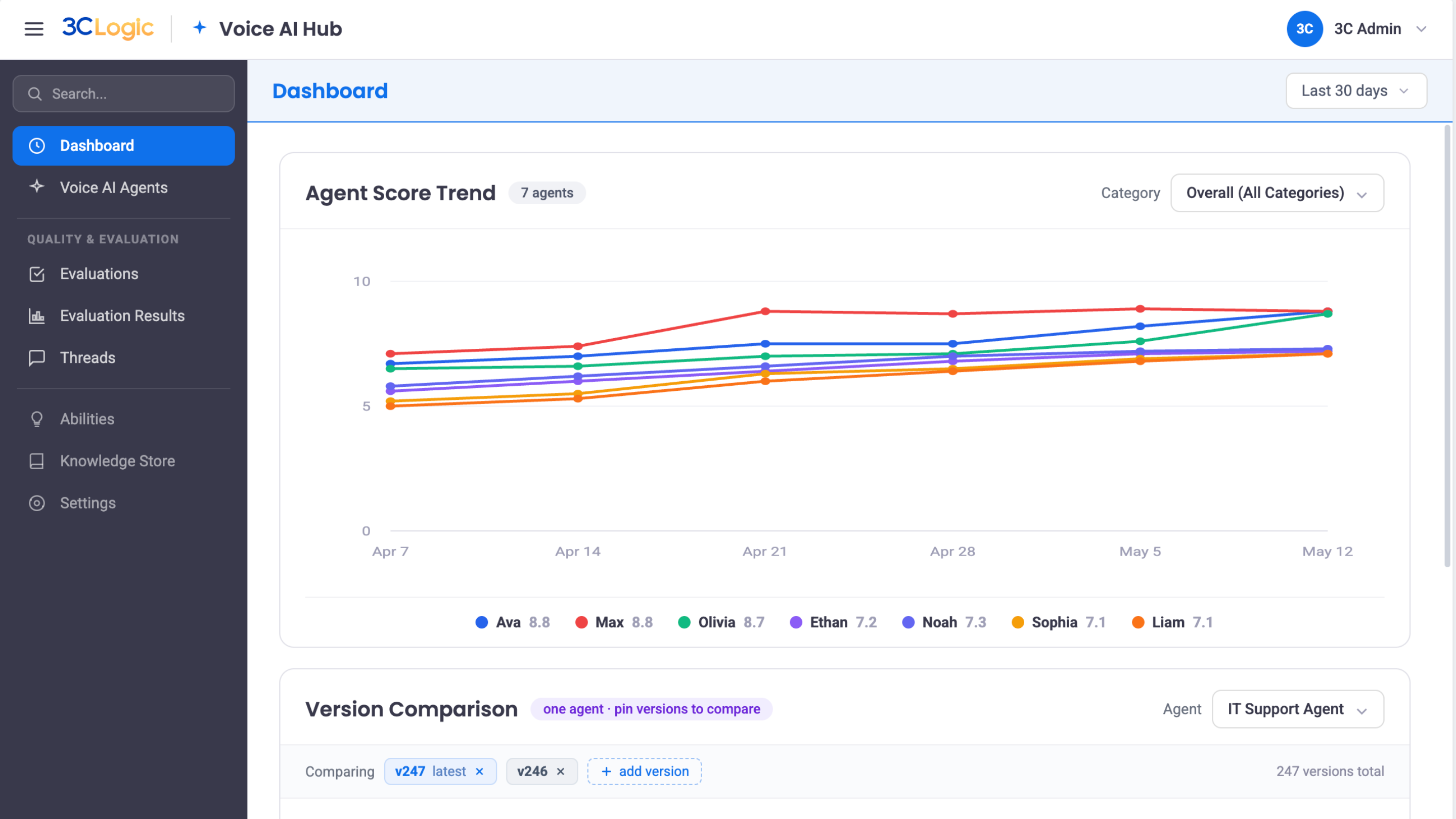

Contact center leaders face a persistent challenge: customer service expectations continue to rise, yet budgets remain stubbornly flat. Teams are pressured to deliver faster resolutions and more personalized support without the option of adding headcount, all while trying to prevent agent burnout. Fortunately, modern cloud contact center platforms equipped with Voice AI capabilities offer a proven solution to this dilemma. By leveraging powerful tools like automated self-service, intelligent interaction distribution, and real-time transcription, organizations can significantly reduce operational costs and overhead while simultaneously improving the overall customer experience.
7 ways voice AI lowers contact center costs
- 1. Automated self-service: Voice AI handles routine requests like password resets and status checks without agent involvement
- 2. Intelligent routing & experiences: AI directs conversations to the right resources based on intent, reducing misrouted contacts
- 3. Real-time transcription and summarization: eliminates post-conversation documentation work for agents
- 4. 24/7 multilingual support: extends service hours without adding headcount across time zones and languages
- 5. Workflow-connected conversations: links voice interactions directly to service platforms and systems of record, removing duplicate data entry
- 6. Speech analytics and insights identifies trends and coaching opportunities to improve first-contact resolution
- 7. Proactive outbound engagement: automates appointment reminders and follow-ups to reduce inbound volume
How we identified these cost reduction strategies
Contact center leaders face a familiar challenge: service expectations keep rising while budgets remain flat. They need to deliver faster resolutions, better experiences, and more personalized support without adding headcount or burning out their teams.
The following represent proven approaches where cloud contact center platforms and Voice AI capabilities directly reduce operational costs while improving customer experience. We evaluated each approach based on:
- Measurable cost impact: Does this strategy reduce labor costs, handle time, or operational overhead in ways you can track?
- Experience preservation: Can you cut costs without frustrating customers or creating friction in the service journey?
- Implementation practicality: Is this achievable with modern cloud platforms connected to your existing service workflows?
- Scalability: Will the approach deliver increasing returns as contact volume grows?
- Agent productivity: Does this free your team to focus on complex, high-value interactions?
way Number 1
1. Automated self-service for routine requests
#1. Automated self-service for routine requests
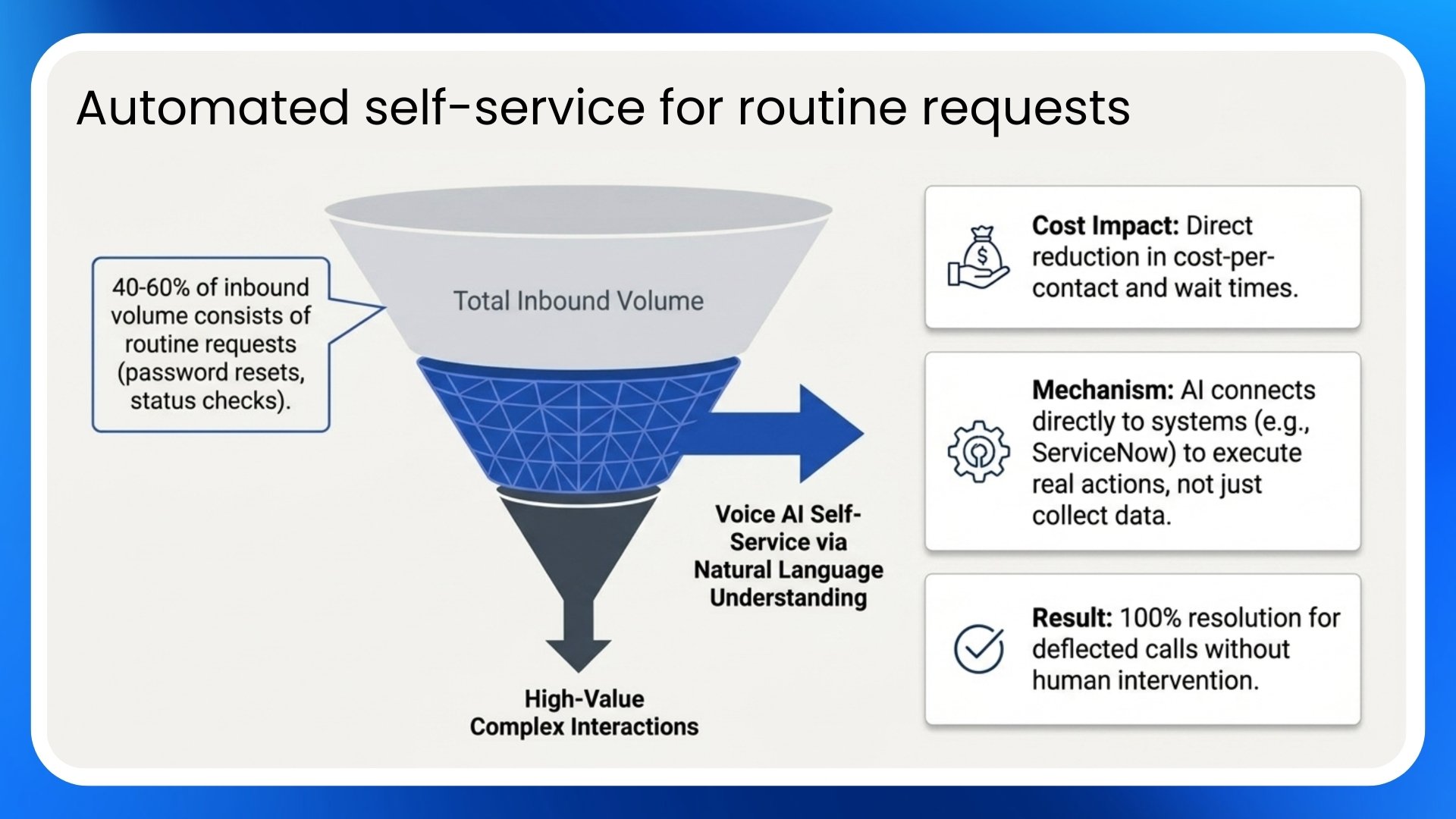
Routine requests consume a significant portion of contact center capacity. Password resets, appointment changes, order status checks, and case updates can account for 40-60% of inbound volume in many organizations. Each of these interactions carries the full cost of agent handling, even when the resolution is straightforward.
Voice AI changes that equation. 3CLogic enables self-service automation that handles these routine requests through natural voice interactions, connecting directly to the workflows and systems that resolve them. Instead of waiting for an agent, customers get immediate resolution while your team focuses on the moments that require human judgment.
The cost impact is direct and measurable. Organizations using 3CLogic's Voice AI for self-service report significant conversation deflection rates, with routine requests resolved automatically before reaching a live agent. This means lower cost per contact, shorter wait times for customers who do need agent support, and better utilization of your most expensive resource: skilled service professionals.
Self-service automation features:
- Natural language understanding: customers speak naturally instead of navigating menu trees, reducing abandonment and improving resolution rates
- Workflow integration: Voice AI connects to systems of record (ServiceNow, Halo Service Solutions, etc.) to execute actual service actions, not just collect information
- Context preservation: when an escalation is needed, the full conversation history transfers to the agent, eliminating repeat explanations
- Continuous learning: AI improves over time based on interaction patterns and outcomes, expanding what can be resolved automatically
way Number 2
2. Intelligent routing & experiences
Misdirected conversations cost money twice. First, there is the wasted time when a customer reaches someone who cannot help them. Second, there is the additional handling when they get transferred to the right resource. In complex enterprise environments with multiple departments and skill sets, misrouted contacts can add 20-30% to average handle times.
Voice AI addresses this by understanding intent from the first moment of the conversation. Rather than relying on customers to select the right menu option or describe their issue to a generalist, AI analyzes the callers intent and connects them to the appropriate resource immediately. 3CLogic's intelligent interaction management capabilities work directly with your service platform to match conversations with the right queues, agents, or automated workflows.
The result is faster time to resolution, lower transfer rates, and better first-contact resolutions. Agents spend less time redirecting customers and more time solving problems they are equipped to handle.
Intelligent routing features:
- Intent recognition: AI understands what customers need based on natural speech, not button presses
- Skills-based matching: conversations route to agents with the specific expertise to resolve them
- Priority handling: urgent requests receive appropriate escalation based on business rules and customer context
way Number 3
3. Real-time transcription and automated summarization
#3. Real-time transcription and automated summarization
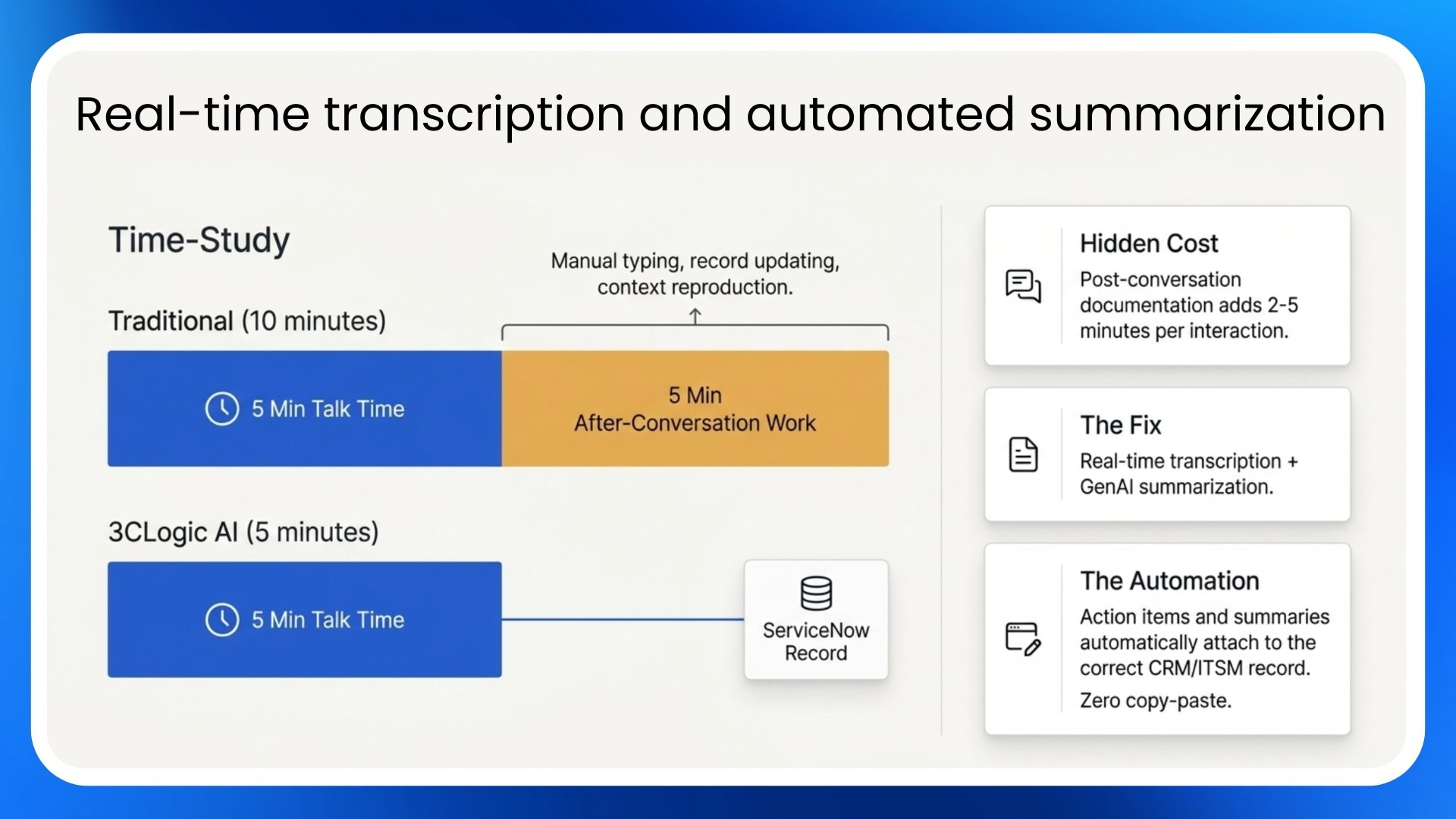
Post-conversation documentation is one of the hidden cost drivers in contact centers. After every interaction, agents spend time typing notes, updating records, and ensuring the next person who views the case understands what happened. This after-conversation work can add 2-5 minutes per interaction, representing significant labor cost across thousands of daily conversations.
3CLogic addresses this with real-time transcription and GenAI-powered auto-summarization. Every voice interaction is transcribed as it happens, with AI generating concise summaries that capture key details, action items, and outcomes. These summaries attach directly to the relevant record in a customers CRM or system of record (ServiceNow case, Halo ITSM incident, etc.).
Organizations using 3CLogic report substantial reductions in after-conversation work time. Agents move to the next customer interaction faster, documentation quality improves because it is captured in real-time rather than reconstructed from memory, and supervisors gain better visibility into what actually happened during conversations.
Transcription and summarization features:
- Real-time transcription: conversations are captured as they happen with industry-leading accuracy
- Automated summarization: AI generates actionable summaries highlighting key points and next steps
- Automatic record association: transcripts and summaries attach to the correct service record without copy-paste or data entry
- Searchable conversation history: past interactions become discoverable for training, quality assurance, and trend analysis
way Number 4
4. 24/7 multilingual support without added headcount
#4. 24/7 multilingual support without added headcount
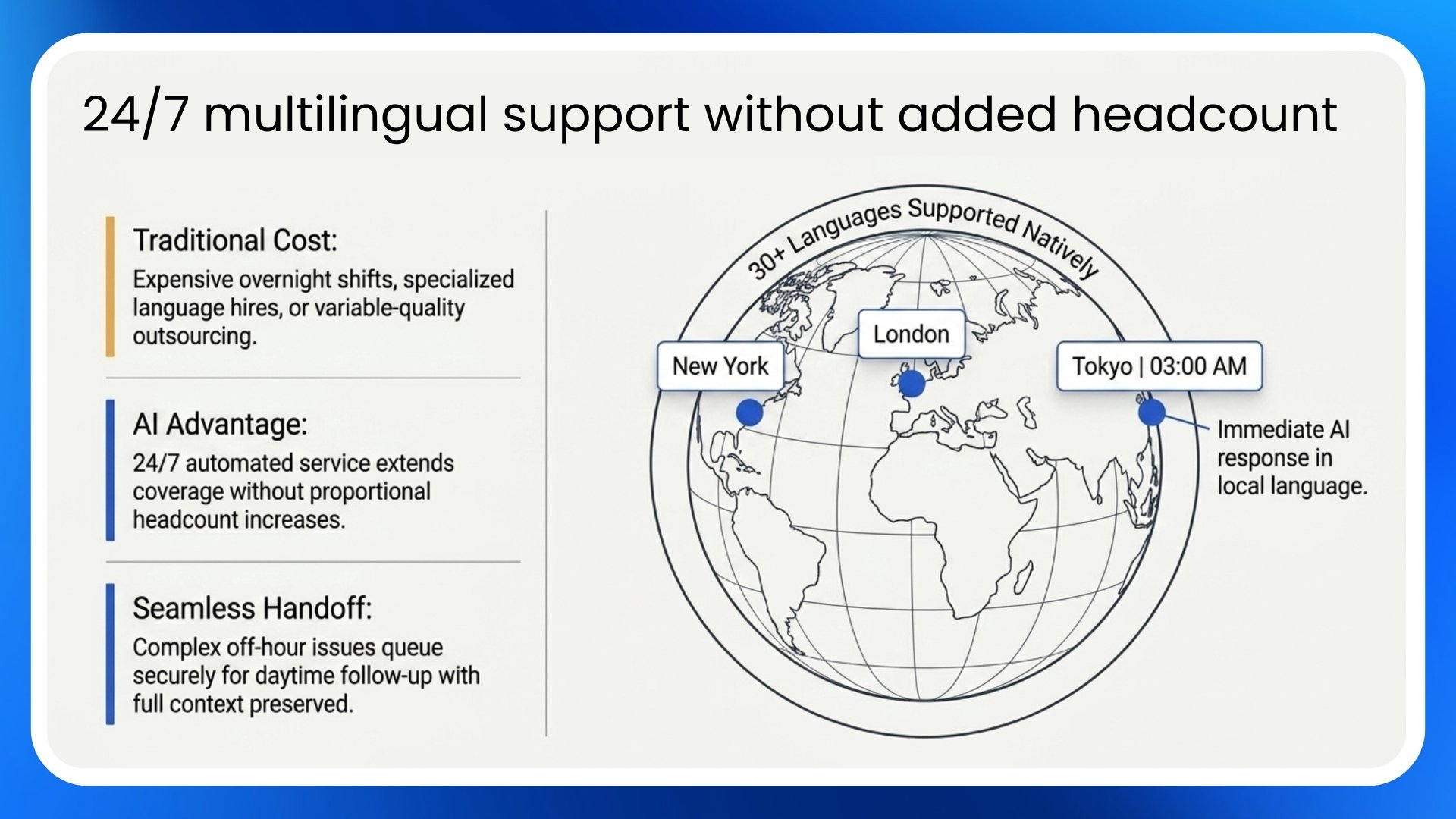
Global organizations face a difficult staffing equation. Providing round-the-clock support across multiple time zones and languages traditionally requires either expensive overnight shifts or distributed teams that are difficult to manage. Adding language capabilities often means hiring specialized agents or outsourcing to third parties with variable quality.
Voice AI expands your service availability without proportional headcount increases. 3CLogic supports 30+ languages for global deployments, enabling self-service and automated interactions around the clock. Customers in Tokyo get the same immediate response at 3 AM as customers in New York get at noon, without requiring live agents to cover every hour.
This approach reduces the cost of 24/7 coverage while improving experience for customers outside standard business hours. Routine requests resolve automatically regardless of time zone, and complex issues can queue for follow-up during regular hours with full context preserved.
Multilingual support features:
- 30+ language support: Voice AI understands and responds in the customer's preferred language
- Time zone flexibility: automated service extends coverage without overnight staffing
- Consistent experience: customers receive the same service quality regardless of when or where they contact you
way Number 5
5. Workflow-connected conversations
Traditional contact center platforms manage conversations. They handle the voice connection, queue the interaction, and connect customers to agents. But they often sit outside the systems where service work actually happens. This creates disconnection: agents toggle between phone systems and service platforms, data gets duplicated across tools, and context gets lost in the gaps.
3CLogic eliminates this disconnection by embedding voice directly into the service platforms enterprises already rely on (ServiceNow, Halo Service Solutions, etc.), connecting every voice interaction to the workflow that resolves it. Agents work from a unified experience, screen pops deliver customer context before the conversation begins, and actions taken during the conversation update the service record automatically.
This workflow-centered approach reduces the cost of context switching and duplicate data entry. Agents are more productive because they are not toggling between tools. Data quality improves because information flows automatically between systems. And resolution happens faster because voice interactions trigger the same workflows that drive service delivery.
Workflow integration features:
- Native CRM and system of record integrations: Voice capabilities embedded directly into what you already use (ServiceNow, Halo Service Solutions) across IT, customer support, HR, and other workflows
- Automated ticket creation: new cases generate automatically based on conversation content and intent
- Screen pops with context: agents see customer history and relevant data before answering
- Unified agent workspace: Voice, SMS, and digital conversations managed from one connected environment
way Number 6
6. Speech analytics and actionable insights
Understanding why contacts happen is essential for reducing their volume. But manual call monitoring captures only a fraction of interactions, and written surveys miss the nuance of voice conversations. Without systematic analysis, contact centers operate on assumptions rather than evidence.
3CLogic's AI-powered speech analytics evaluate every conversation to surface trends, sentiment, and performance insights. Leaders gain visibility into what customers are asking, where processes break down, and which agents need coaching. This intelligence enables targeted improvements that reduce repeat contacts and improve first-contact resolution.
The cost impact comes from addressing root causes rather than treating symptoms. When analytics reveal that 15% of contacts come from confusion about a specific policy, you can fix the policy communication once rather than handling those contacts indefinitely. When coaching opportunities emerge from conversation patterns, supervisors can focus development where it will improve outcomes.
Analytics and insights features:
- Sentiment detection: AI identifies customer emotion and satisfaction signals across all conversations
- Trend identification: patterns emerge from aggregate conversation data, highlighting improvement opportunities
- Agent performance metrics: individual and team analytics support targeted coaching and recognition
- Quality assurance automation: AI assists with QA evaluation, enabling broader coverage than manual review
way Number 7
7. Proactive outbound engagement
#7. Proactive outbound engagement
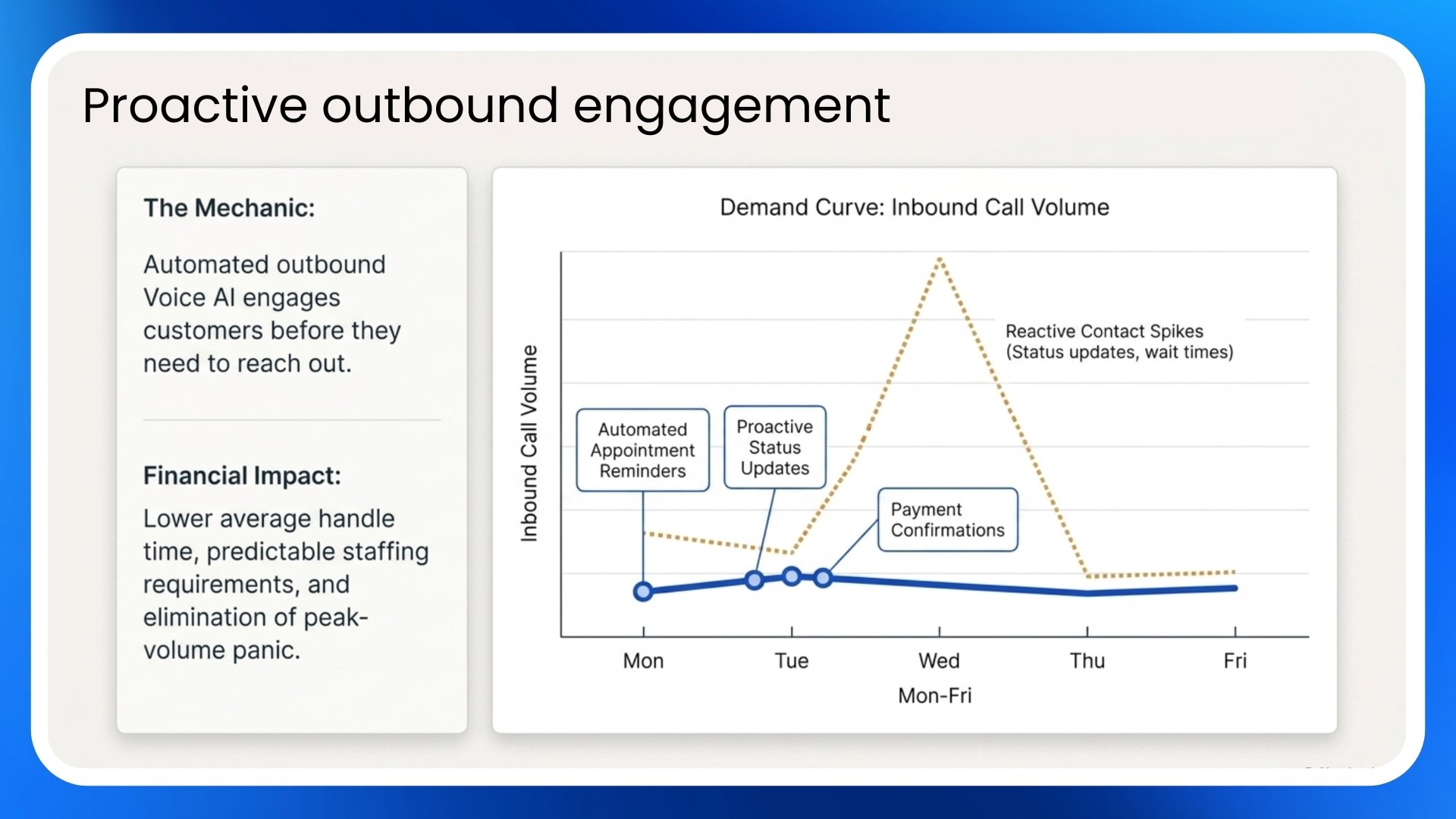
Many inbound contacts are preventable. Customers contact service teams because they are waiting for updates, need appointment reminders, or want confirmation that something happened. Each of these reactive contacts costs money that proactive communication could eliminate.
Voice AI enables automated outbound engagement that keeps customers informed before they need to reach out. 3CLogic supports both inbound and outbound Voice AI agents for proactive and reactive workflows. Appointment reminders, status updates, payment confirmations, and follow-up surveys can all be automated, reducing the inbound volume that requires agent handling.
This proactive approach shifts the cost equation. Instead of staffing for peak inbound volume, you can flatten demand by keeping customers informed. The result is lower average handle time, better customer satisfaction from timely updates, and more predictable staffing requirements.
Proactive engagement features:
- Automated reminders: appointment confirmations and reminders reduce no-shows and follow-up contacts
- Status notifications: customers receive updates on their requests without needing to contact you
- Survey collection: post-interaction feedback gathered automatically while the experience is fresh
- Campaign integration: outbound engagement connects to CRM workflows for coordinated customer communication
How do cloud contact centers reduce infrastructure costs?
Traditional on-premises contact center infrastructure carries substantial capital and operational costs. Hardware, maintenance, telecom circuits, and IT staff to manage it all add up quickly. Upgrades require significant projects, and scaling for peak periods means owning capacity you rarely use.
Cloud contact center platforms eliminate much of this overhead. There is no hardware to purchase or maintain, no circuits to manage, and no upgrade projects to schedule. Capacity scales automatically based on demand, so you pay for what you use rather than what you might need. Global availability comes from the platform rather than from building infrastructure in every region.
This shift from capital expense to operating expense also improves financial flexibility. You can start with the capabilities you need today and expand as requirements grow, without committing to infrastructure investments upfront.
What role does AI play in reducing agent burnout?
Agent turnover is one of the most significant hidden costs in contact centers. Recruiting, training, and ramping new agents consumes resources, and high turnover means constantly operating below optimal productivity. Burnout from repetitive interactions and overwhelming volume drives much of this turnover.
Voice AI addresses burnout by removing the repetitive interactions that exhaust agents. When AI handles password resets, status checks, and routine requests, agents focus on the complex, meaningful work that attracted them to service roles. They solve problems, build relationships, and exercise judgment rather than repeating the same scripts hundreds of times.
3CLogic enhances this effect by giving agents better tools for the conversations they do handle. Real-time transcription means less typing. Automated summarization means less documentation. Context-rich screen pops mean less repetitive questioning. Agents can focus on the human elements of service rather than the administrative overhead.
FAQs about voice AI and contact center costs
How quickly can Voice AI reduce contact center costs?
Many organizations see measurable cost impact in the first few months of deployment. Self-service automation delivers immediate volume reduction as routine requests shift from agent handling to AI resolution. 3CLogic's real-time transcription and auto-summarization reduce after-conversation work from the first day of use.
Does Voice AI hurt customer experience to save money?
Modern Voice AI improves experience while reducing costs. Customers get faster resolution for routine requests without waiting for agents. When human support is needed, 3CLogic ensures agents have full context and conversation history. The goal is better service at lower cost, not cheaper service that frustrates customers.
What types of interactions can Voice AI handle automatically?
Voice AI handles a wide range of routine interactions including password resets, appointment scheduling and changes, order status inquiries, case updates, account balance checks, and basic troubleshooting. 3CLogic connects these automated interactions directly to your service platform so AI can execute real actions, not just collect information.
How does workflow integration reduce contact center costs?
Workflow integration eliminates the hidden costs of disconnected systems. Agents stop toggling between tools, data stops getting duplicated across platforms, and context stops getting lost in handoffs. 3CLogic's integration with CRMs and systems of records means voice interactions connect directly to the workflows that resolve them, reducing handling time and improving data quality.
Can voice AI work with our existing CRM or service platform?
Yes, 3CLogic integrates with leading enterprise platforms including ServiceNow, Halo Services Solutions, SAP and others.
What is the difference between Voice AI and traditional IVR?
Traditional IVR requires customers to navigate button-press menus and listen to options. Voice AI understands natural speech, recognizes intent, and takes action based on what customers actually need. 3CLogic's Voice AI connects to backend systems to resolve requests, not just route contacts to agents.