
Voice AI has moved well beyond experimentation and into production. In 2026, roughly two-thirds (66%) of customer service organizations reported using AI agents, up from 39% in 2025, according to Salesforce's State of Service research. Gartner also reports that 91% of customer service and support leaders are now facing direct executive pressure to deploy AI. At the same time, Forrester estimates that voice AI is already handling close to one-fifth of inbound contact-center volume, nearly three times its share in 2024.
For service desk and support leaders, the question has changed. The debate is no longer about whether to put a Voice AI agent in front of customers. The bigger issue is whether you can prove it — across every interaction, not a sample. Is the agent resolving problems correctly? Following through on commitments? Meeting compliance requirements? Protecting the customer experience?
For many organizations, that visibility is still missing. And that lack of oversight can quickly become the weak point in an otherwise successful AI deployment.
Your Voice AI Agent Is Live. Can You Prove It’s Performing?
The Problem: Your Agent Is Running, but You Have Limited Visibility
When a human support agent begins struggling, there are usually signals. Escalations increase. A quality reviewer notices a pattern. A supervisor steps in. Coaching follows. With Voice AI, the human agent disappears from the interaction. Unless the right controls are put in place, much of the visibility that traditionally came with human supervision disappears as well.
Once an AI agent is operating at scale, several challenges become difficult to ignore.
Why don't traditional metrics catch these failures?
A Voice AI agent may handle thousands of interactions every day, with each conversation unfolding differently. It can misunderstand a customer's intent, provide incorrect information with confidence, miss a mandatory disclosure, or tell a customer that an action was completed when it was not. Those failures may never appear in metrics such as containment rate or average handle time — numbers that tell you an interaction ended, but not whether the customer got the right outcome.
Why can't manual QA keep up with Voice AI?
Historically, most contact-center QA programs review only 1–2% of calls. That approach made sense when every reviewed call required a person to listen and evaluate it manually — but it also means the vast majority of interactions go unscored. With a Voice AI agent, the same error can repeat across hundreds of calls before one of those conversations happens to be selected for review. At that point, sampling isn't just a limitation. It's a blind spot. Problems may only surface after a customer escalates, complains, or leaves.
What happens when nobody notices the pattern?
Qualtrics XM Institute estimates that poor customer experiences put roughly $3.7 trillion in global sales at risk. Yet fewer than one in three customers now provide feedback after a poor experience; many simply leave without saying anything. PwC has reported that 32% of customers will stop doing business with a brand they love after a single bad experience. If a Voice AI agent repeats the same mistake without triggering an obvious escalation, the business may not recognize the damage until customers have already walked away.
What are analysts warning about?
Gartner predicts that more than 40% of agentic AI projects will be canceled by the end of 2027, citing escalating costs, unclear business value, and inadequate risk controls.
Forrester's 2026 research points to the same challenge from another angle: autonomous systems that operate without continuous human oversight may deliver real value, but they need monitoring that runs alongside them — not a quarterly review of a system that's making decisions and talking to customers every day. Forrester has also predicted that roughly one-third of brands will erode customer trust in 2026 by rolling out generative AI self-service before it's ready.
The implication is straightforward. Deploying a Voice AI agent without a reliable way to evaluate its behavior creates a governance issue, a compliance risk, and a brand risk — and trust in the agent ultimately depends on your ability to verify what it's doing.
The Solution: Automatically Evaluate Every Conversation
The answer is not to slow down AI adoption. It is to introduce the same kind of structured performance management that would exist for a new employee, but in a way that can operate at machine scale.
That is the purpose of AI Evaluations.
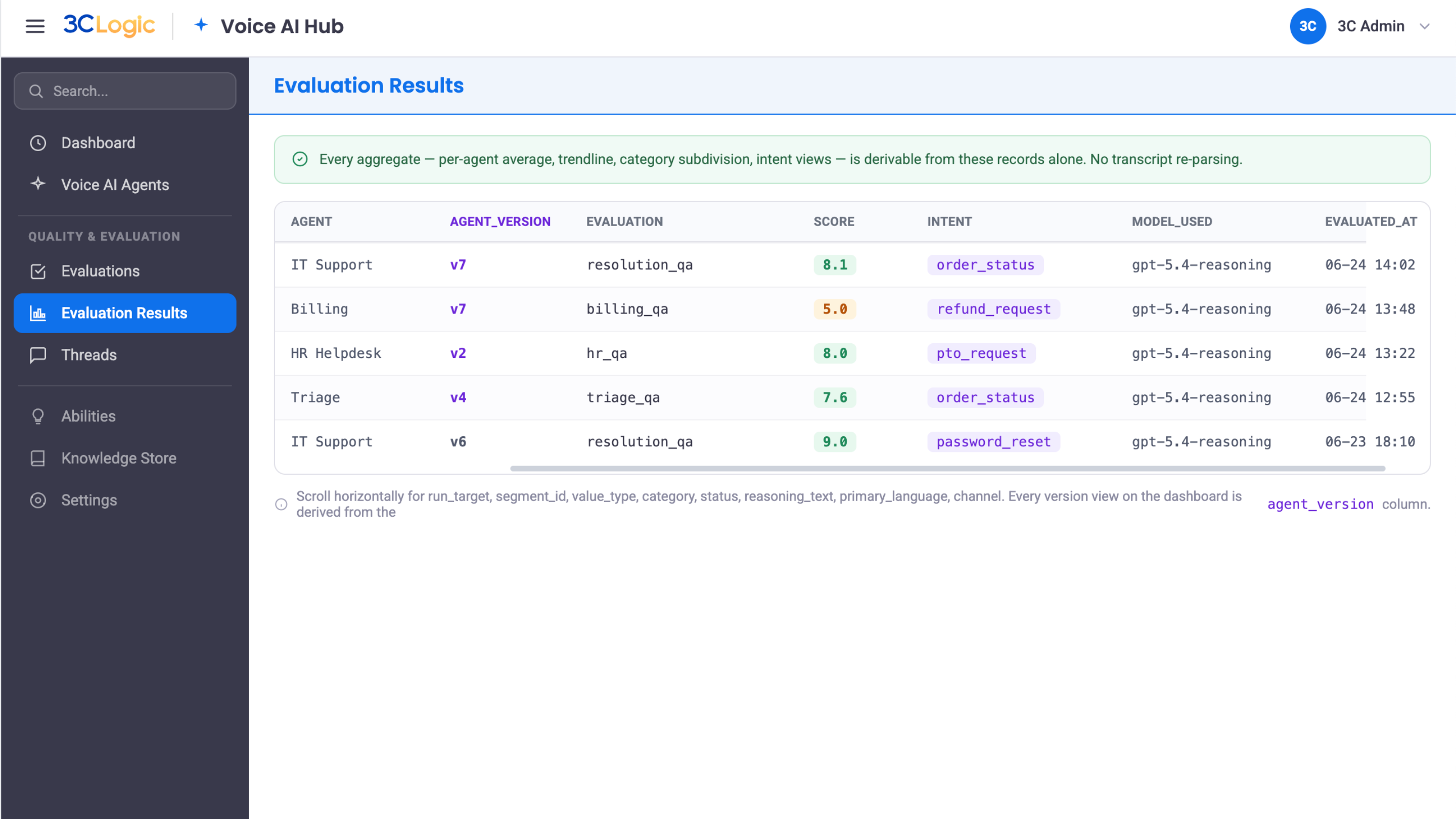
AI Evaluations acts as an automated quality-assurance layer for the AI agent itself. After every Voice AI interaction, the system reviews the customer-facing conversation and assigns performance scores on a 0–10 scale, along with written reasoning explaining each score. There is no sampling, no review queue, and no requirement for a human evaluator to listen to every interaction. Just as importantly, the agent is not judged against a generic scorecard — the evaluation criteria can be aligned with the specific job that agent is expected to perform.
Performance can be assessed across categories such as:
- Resolution — did the agent actually resolve the customer's issue?
- Sentiment — how did the customer feel during the interaction?
- Compliance — were required disclosures provided and escalation requests handled appropriately?
- Accuracy — was the information the agent provided correct?
- Goal — did the interaction accomplish the specific objective assigned to that agent?
Illustrative scores — actual weighting and thresholds are configured per agent.
Individual measurements roll into category scores, and those category scores combine into a weighted composite score for the agent. That gives leaders a single number to monitor, while preserving the ability to investigate the specific area responsible for a change in performance.
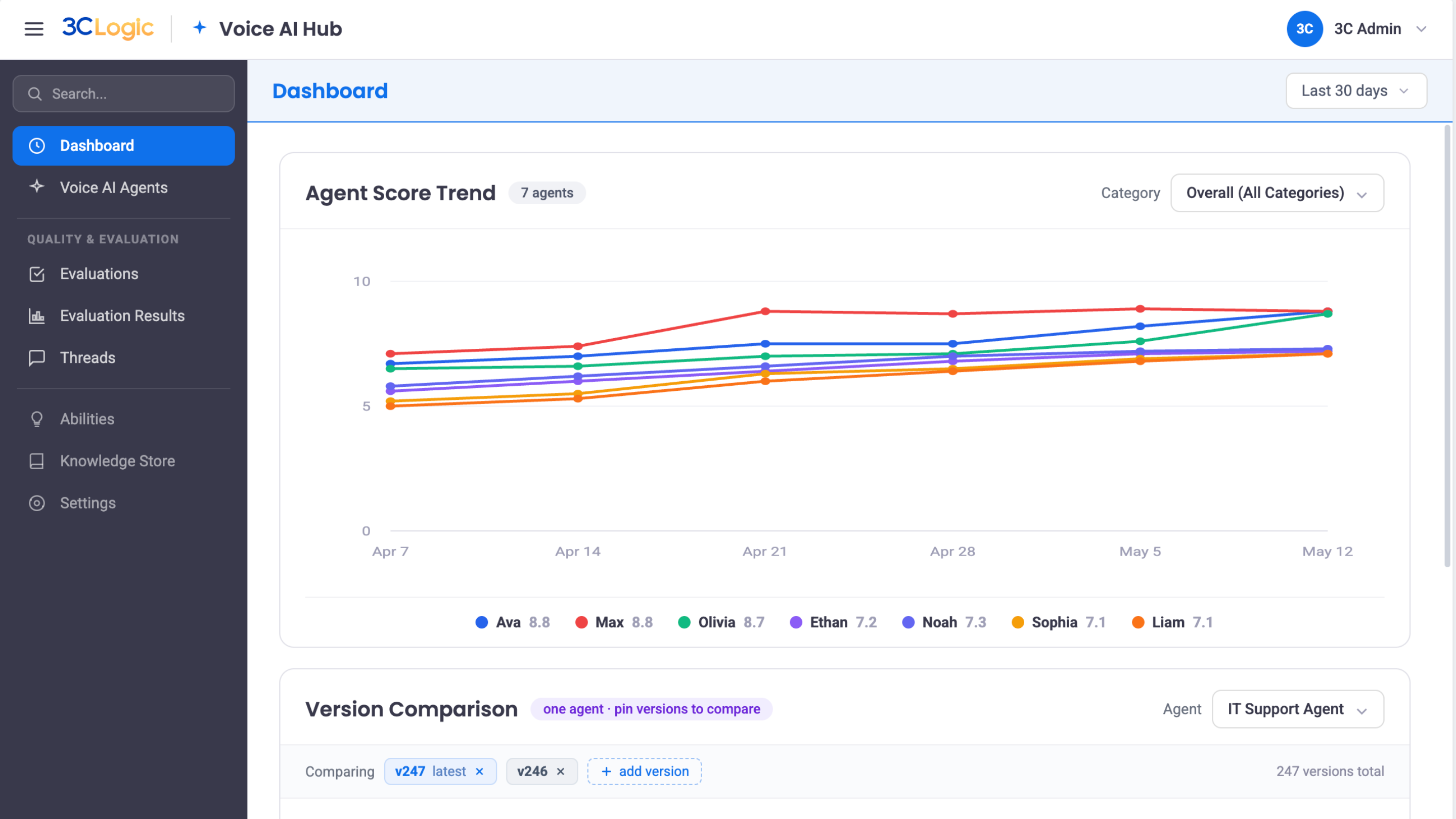
Scores and the reasoning behind them stay attached to the underlying conversation. They can then feed dashboards that show performance trends over time and let teams compare one version of an agent with another.
One of the most important design principles is that the business defines what "good" means. An administrator can set the evaluation criteria in plain language — no data-science team, lengthy integration project, or universal QA framework required, since not every AI agent should be judged the same way. A billing agent, an IT support agent, and a triage agent perform different jobs. Their evaluation criteria should reflect those differences.
Manual QA vs. automated AI Evaluations
| Dimension | Manual QA | AI Evaluations |
|---|---|---|
| Coverage | 1–2% of calls sampled | 100% of conversations scored |
| Consistency | Varies by reviewer; subject to fatigue | Same criteria applied every time |
| Time to detect an issue | Weeks — often after a complaint | Hours |
| Evidence for compliance | Assumed, rarely documented | Auditable record per conversation |
| Evaluation criteria | Often one generic scorecard | Defined per agent / use case |
The Value: How Continuous Evaluation Changes Operations
Continuous evaluation is more than an additional reporting capability. It changes both the economics and the risk profile of running Voice AI in production. QA coverage can move from 2% to 100%. Instead of evaluating a small sample and assuming it represents the entire population of calls, every conversation can be scored against the same standards — removing reviewer fatigue and inconsistency while eliminating the large share of interactions that would otherwise never be examined.
Quality becomes measurable at the leadership level
A composite agent score that's tracked over time and broken down by category gives leaders a more practical way to manage performance. If quality falls, teams can identify which category changed and investigate immediately, rather than waiting for a customer escalation weeks later. Supervisors also spend less time searching through recordings to find calls worth reviewing — the evaluation reasoning is already attached to the relevant interaction and can be searched and filtered.
Can you tell if the agent kept its promises?
This is particularly important in Voice AI. If an agent tells a customer, "I've filed that for you," the evaluation can determine whether that action actually happened. The same principle applies to escalation requests that were supposed to be honored and required disclosures that were supposed to be delivered. Instead of assuming those steps happened, the organization has an auditable record across every conversation — compliance evidence rather than compliance assumptions.
Teams can make agent changes with greater confidence
Version comparison lets organizations measure a new agent build against the previous version, before and after deployment, making it easier to tell whether a change improved or degraded performance. Teams can tune the agent faster because they can see the effect of individual changes, and they can roll back based on measurable evidence rather than isolated anecdotes — the kind of operational discipline that separates the agentic AI initiatives that endure from the more than 40% Gartner expects to be canceled.
QA can also become a source of customer intelligence
When the same system identifies the intent behind every conversation, customer contact reasons become measurable trends. That means the evaluation platform isn't only identifying failures — it's also helping organizations understand what customers are asking for and what issues are driving interactions. That insight can be valuable well beyond the QA organization.
What's the ROI case?
It's relatively simple. Reviewer time shifts away from searching for problems and toward solving them. Issues get identified in hours rather than after a customer has already left. In an environment where a single poor experience can end a customer relationship, moving from reactive quality control to proactive evaluation can determine whether a Voice AI deployment strengthens customer trust — or quietly undermines it.
The Takeaway
Deploying Voice AI is increasingly becoming the easy part. Proving that it performs consistently is the harder challenge.
The organizations gaining an advantage in 2026 are not necessarily the ones deploying the largest models. They are the ones that can demonstrate, interaction by interaction, that their AI agents are delivering the outcomes they were designed to produce.
Automated evaluation turns a Voice AI agent from a production black box into a system that can be measured, improved, governed, and supported with evidence. If an AI agent represents your organization in front of customers, it needs what any high-performing team needs: a reliable way to know how it's doing — not from the customer telling you after the fact.

See what your AI agents are really doing
Book a walkthrough of AI Agent Evaluator and see evaluation scoring, reasoning, and dashboards on your own use cases.
FAQ
Sources
- Salesforce, State of Service (2025) — AI agent adoption at 66%, up from 39%; time-to-value data.
- Gartner (2025) — 91% of customer service and support leaders under executive pressure to deploy AI; prediction that over 40% of agentic AI projects will be canceled by end of 2027 due to escalating costs, unclear value, and inadequate risk controls; forecast that agentic AI will autonomously resolve 80% of common service issues by 2029 with ~30% lower operating costs.
- Forrester, The State of Agentic AI in 2026 — oversight requires instrumentation that runs while the agent runs; voice AI share of inbound contact-center volume (~19% in 2026 vs. ~6% in 2024). 2026 B2C Predictions — roughly one-third of brands will erode customer trust through premature AI self-service.
- Qualtrics XM Institute, Consumer Experience Trends — ~$3.7 trillion in global sales at risk from poor experiences fewer than one in three customers provide feedback after an experience.
- PwC, Future of Customer Experience — 32% of customers leave a brand they love after one bad experience.
Note: Analyst figures are attributed to their originating firms and reflect publicly reported research current as of 2026. Some Gartner predictions carry a 2027–2029 horizon.